Let nothing disturb you, let nothing frighten you. All things pass; God does not change. Patience gains all it seeks. Whoever has God lacks nothing: God alone is enough.
Showing posts with label Day off. Show all posts
Monday, April 22, 2013
Not the Normal Day Off
It has been a 'long week' as they say, and, despite attempts to keep up with studying Latin and get papers written, it has nonetheless been remarkably unproductive time. Although Monday and (unexpectedly) Friday had no classes, all the excitement and tension made it rather difficult to concentrate (not to mention the noise!)
It has been one week since the Boston Marathon bombing, and although things have quieted down a over the weekend after the manhunt craziness, there is a reminder just down the street of all the victims affected. Fr. John Wykes, the resident media guru, made a short film of footage from the barricade. It is a simple but fitting tribute.
Tuesday, April 16, 2013
Divine Mercy, and Providence
I expected to write a post with a much lighter tone today.
Yesterday was my first visit to the National Shrine of the Divine Mercy in Stockbridge, MA. As it turns out, Fr. Michael Gaitley, MIC went through formation with the OMVs before he joined the Marians and was the classmate of my neighbor-across-the-courtyard and barber Br. Jerry. He is currently the director of the Shrine and Marian Helper Center, as well as a well-known author. (In fact, he wrote his first book, Consoling the Heart of Jesus, while a seminarian with the OMVs. It really makes one think about the use of one's time...).
Fr. Greg, currently assigned in the Philippines, is visiting Boston and wanted to go to the Shrine so I fortuitously decided to tag along with him and Br. Jerry at the last minute (instead of going to watch at the Boston Marathon finish line as I had planned).
Fr. Michael cleared his schedule and spent the entire afternoon with us. We got a thorough update on new happenings with the Marians and a tour of their publishing center, which has recently been expanded to include a state-of-the-art gallery wrapping facility where reproductions of the Divine Mercy images are digitally impressed on canvas, stretched, and wrapped on wooden frames. It is part of the MIC's expansion of their apostolate in distribution of Divine Mercy images.


In fact, many of the images that they (and others) have circulated for the passed half century have been revitalized by new digital copying and image editing technology in the last few years. One of these projects was the restoration of an original image from Lithuania started in the year 2000 and, more recently, continued work in digital enhancement to restore details lost through years of neglect.


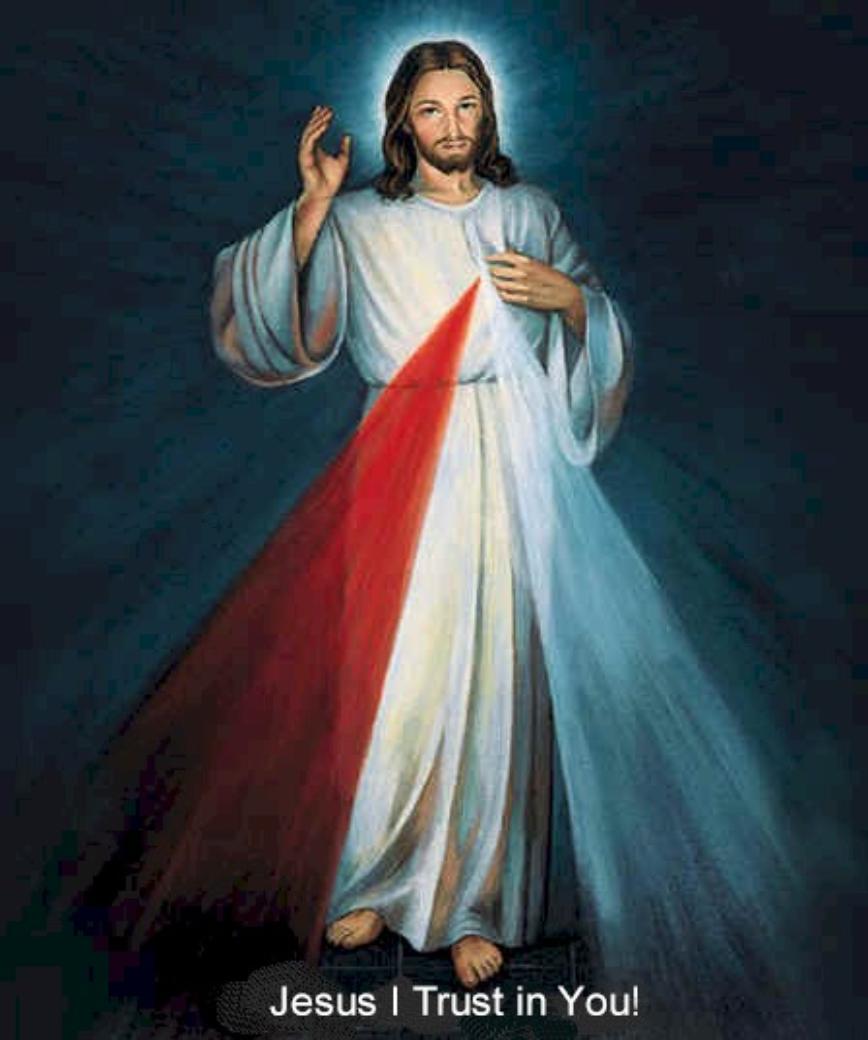
There are many versions of the Divine Mercy image (as revealed to St. Maria Faustina, that "Not in the beauty of the color, nor in the brush lies the greatness of this image, but in My grace."). But there is only one that St. Faustina herself directed to have painted, known as the "Vilnius image" because of where it was painted. She reportedly wept after the artist's twelfth attempt to portray her description of her vision of Jesus, but realized it was grace and not the art that would change hearts. Despite this, the piece has several distinctive features that other popular images such as the Hyla (above) and Skemp versions do not. The Vilnius image is less well-known because Lithuania ended up part of the Soviet Union after the war and replicas were not easily obtainable. But it is regaining attention now that it is accessible and has had fifty-plus years of candle soot removed.
Thank you to everyone who has been praying and offering support: it has been very comforting. I had an especially difficult time returning to my hospital apostolate this morning. Although I did not see any of the victims (but may when some begin rehab in a couple weeks), many of the patients had raw feelings surrounding their own accidents and injuries come up for discussion. Even though it was challenging, there were many opportunities for emotional healing and, by God's Mercy, small conversions of heart. So please keep praying!
Yesterday was my first visit to the National Shrine of the Divine Mercy in Stockbridge, MA. As it turns out, Fr. Michael Gaitley, MIC went through formation with the OMVs before he joined the Marians and was the classmate of my neighbor-across-the-courtyard and barber Br. Jerry. He is currently the director of the Shrine and Marian Helper Center, as well as a well-known author. (In fact, he wrote his first book, Consoling the Heart of Jesus, while a seminarian with the OMVs. It really makes one think about the use of one's time...).
Fr. Greg, currently assigned in the Philippines, is visiting Boston and wanted to go to the Shrine so I fortuitously decided to tag along with him and Br. Jerry at the last minute (instead of going to watch at the Boston Marathon finish line as I had planned).
Fr. Michael cleared his schedule and spent the entire afternoon with us. We got a thorough update on new happenings with the Marians and a tour of their publishing center, which has recently been expanded to include a state-of-the-art gallery wrapping facility where reproductions of the Divine Mercy images are digitally impressed on canvas, stretched, and wrapped on wooden frames. It is part of the MIC's expansion of their apostolate in distribution of Divine Mercy images.
In fact, many of the images that they (and others) have circulated for the passed half century have been revitalized by new digital copying and image editing technology in the last few years. One of these projects was the restoration of an original image from Lithuania started in the year 2000 and, more recently, continued work in digital enhancement to restore details lost through years of neglect.
Example of digital image restoration undertaken by the Marians.
There are many versions of the Divine Mercy image (as revealed to St. Maria Faustina, that "Not in the beauty of the color, nor in the brush lies the greatness of this image, but in My grace."). But there is only one that St. Faustina herself directed to have painted, known as the "Vilnius image" because of where it was painted. She reportedly wept after the artist's twelfth attempt to portray her description of her vision of Jesus, but realized it was grace and not the art that would change hearts. Despite this, the piece has several distinctive features that other popular images such as the Hyla (above) and Skemp versions do not. The Vilnius image is less well-known because Lithuania ended up part of the Soviet Union after the war and replicas were not easily obtainable. But it is regaining attention now that it is accessible and has had fifty-plus years of candle soot removed.
Vilnius Image
Immediately after praying the chaplet at 3:00 was when we first heard about the bombings in Boston. Things were chaotic for a while as all the Oblates were being accounted for; Copley Square is only a few blocks from the shrine and even closer to St. Francis Chapel, and because it was a day off, many of us had been about town by ourselves. Fortunately, four of us who had considered going down to the finish line were elsewhere for one reason or another.
Over the next few hours, we debated whether to try and get back to Boston or stay over at the MIC monastery. I was able to contact family members during the intervening time and let everyone know I was safe. It was difficult because the cell phone network had been suspended in Boston and other people we could communicate with outside the city didn't have complete information about security measures and road closures. We ended up returning but not getting back until late. We were only just able to get home by inbound Boylston Street: the evacuated area ended one block east of us.
Today was in some ways a regular Tuesday, but road blocks and national guardsmen in the neighborhood were a reminder that normality has not returned: a large segment of the city on our doorstep is still accessible only through security checkpoints.
For me, it is very different to have something traumatic happen down the street. Hearing about terrorism in New York or D.C. was simply not as immanent as seeing the sidewalk I walk down several times a week pocked and blood-spattered. And knowing people who were in the area and recount taking cover or being evacuated through alleys before the dust had settled. And knowing that I had very nearly decided to be there myself. Even the tragedies of complete strangers are more evocative when I practically see the scene from the stoop. It feels very close to home.
The visit to the Shrine is salient not only because of the events of the day, but because of personal growth and my Lenten focus on God's Mercy: how I encounter it in my life and how I reflect it to others. It casts all the more relief on how small changes in the spiritual life loom large when the world seems shaken, such as how I react to those who need compassionate care and what I say to those struggling with anger or hatred or nursing wounded hearts, wounds only the grace of God can heal.
Monday, December 3, 2012
Le Visite au Quebec
Sorry it has taken so long, but I have finally sorted through most of my pictures from the Thanksgiving trip to Montreal and Quebec and selected some of the best to post.
St. Joseph's Oratory was the first place we visited. It is a massive basilica complex on the main hill in Montreal. You don't get a good sense of scale from this picture, but it is a gigantic structure.
St. Frere Andre is the Holy Cross brother who founded the Oratory. The lower part of the basilica contains his tomb and a second sanctuary that overlooks the city.
The St. Lawrence- as the trip-long joke on Fr. Guy went, "It's not a river, it's a 'fleuve'"- a special designation for a sea-draining river and also fun to say.
St. Francis Xavier Mission Church in Trois-Riviers, halfway between Montreal and Quebec, contains the remains of St. Kateri Tekahkwitha.
Everything was bilingual in French and Mohawk in the church. It was one of my favorites among the many churches we visited. It is just a simple old mission church, but still very ornate and beautiful.
We also visited the grave of Fr. Braux, one of the Montreal Oblates, near Trois-Riviers.
We stayed in a lakeside chalet owned by a religious community near Quebec. It was very beautiful and it snowed our last night there, but unfortunately those pictures didn't get saved. I taught a couple of the guys Monopoly and managed to play on a French board.
We approached Quebec by the royal entrance- a ferry ride up to the gates of the Old City- which offered a spectacular view of the area, especially the Chateau Frontenac.
L'Eglise des Victoires- the Church of the Victories, names for two important battles won against the British in the sixteenth century, is one of the most famous landmarks.
Rue de le Petit Champlain is a famous shopping area in the Old City seen here from the top of the hill.
The hotel lobby in the Chateau Frontenac.
The Rose Room, where Roosevelt, Churchill, and McKenzie (the Canadian PM not even the Canadians could remember) met during WW II.
The cathedral basilica of Notre-Dame de Quebec.
The tomb of Bl. Francois de Leval, the first bishop of Quebec, is to the right of the sanctuary.
The windows were light, almost pastelle colors- different from any I had seen before.
The remains of my tarte de canard (duck pie)- I forgot to take the picture before eating it.
Ste. Anne de Beaupre is huge mariners' church north of Quebec City. The current structure was completed in the 1950s.
The exterior is undoubtably much more picturesque when the gardens are blooming or there is snow, but the structures are still very impressive: the fountain is about 30 feet tall and all the exterior doors are solid bronze.
The back of the church has racks with hundreds of crutches and canes (as did the crypt at St. Joseph's Oratory) left by people who have been miraculously healed.
The reliquary containing the forearm of Bonne Ste. Anne
The crypt church is much simpler than the basilica and has many airbrush paintings that have been recently added.
Triptych depicting St. Anselm, St. Bernard, the Holy Family, St. Augustine, and St. Ambrose.
At night, beacons at the top of the spires are visible almost all the way to the Gulf of St. Lawrence.
Sampling the wares at a local microbrewery in Beaupre.
Subscribe to:
Posts (Atom)