Let nothing disturb you, let nothing frighten you.
All things pass; God does not change.
Patience gains all it seeks.
Whoever has God lacks nothing:
God alone is enough.
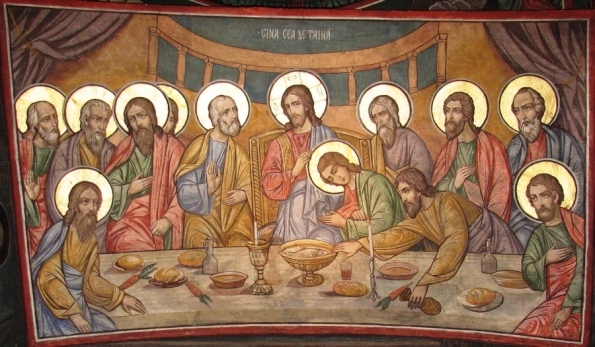
If I, therefore, the master and teacher, have washed your feet, you ought to wash one another's feet. I have given you a model to follow, so that as I have done for you, you should also do.
John 13:15
Ostinato: Bleibet hier und wachet mit mir; wachet und betet. Remain here and watch with me; watch and pray.
Descant: Meine Seele ist zu Tode betrübt. Bleibt hier und wacht mit mir. My soul is troubled unto death. Remain here and watch with me. Setzt euch und wartet hier, während ich dort bete. Sit ye and wait here, while I pray yonder. Father, if it is possible, let this cup pass me by. Father, if this can not pass me by without I drinking it, your will be done
Jesus experienced rejection throughout his ministry. From his first public manifestation at Nazareth, the people wanted to throw him over a cliff; those who tie up burdens hard to bear and do not lift a finger to help were indignant when he admonished their hardness of heart; there were many among the priests who profited from revenue during the Pax Romana and were eager to suppress any anti-imperialism. But none of these succeeded in seizing Jesus; he passed through their midst and went away or entered the city in secret, rather unsophisticated evasions, but they show that they could not lay a hand on Jesus unless he allowed it, and he only allowed it when one of his own betrayed him.
Jesus was invulnerable to the power of the authorities, but not that of his friends; it was by his choice that those he loved had the opportunities to betray and desert him. The vulnerability of Jesus did not end when the helpless infant grew up, but continued as he experienced everything that is in man, including betrayal of trust, the greatest fear and pain in relationship. Jesus foretold betrayal by one, but also that his kenosis was for many for the forgiveness of sins, because he bore all sins and offenses. Let us stand with our mother and look on him whom they have pierced with compunction.
Woe is me, my Child! I see Thee, dearest and beloved Child, hanging upon the cross, and my heart is bitterly wounded. But in Thy love, speak some word to Thy handmaiden. Woe is me, my Child! I wish to take my son down from the wood and to hold Him in my arms as once I held Him when He was a little child; But alas, there is no-one to give Him to me. Woe is me, my Child! I see Thee bruised and wounded, without glory, stripped upon the cross. O my Child, and my heart burns. Woe is me, my Child! In my arms, I hold Thee as a corpse, O loving Lord, who has brought the dead back to life; Grievously is my heart wounded, and I long to die with Thee, for I cannot bear to look upon Thee lifeless and without breath. Woe is me, my Child! I reflect, O Master: how never again shall I hear Thy voice. Never again shall Thy handmaiden see the beauty of Thy face as in the past, for Thou, my Son, hast sunk down before mine eyes. Woe is me, my child! Where dost thou go, my Child? Why dost thou run so swiftly? Is there another wedding in Cana, and are thou hastening there to turn the water into wine? Shall I go with thee, my child, or shall I wait for thee? Speak some word to me, O Word; Do not pass me by in silence. Thou hast preserved my virginity, and thou art my Son and God. Woe is me, my child! Release me from agony and take me with Thee, O my Son and God. Let me also descend with Thee, O Master, into Hell. Leave me not to live alone, for I cannot bear to look upon Thee, my sweet Light. Woe is me, my child! Dost thou change my grief to gladness by Thy Resurrection? Rise, O God, and judge the Earth! Rise, O God, and judge the Earth! Woe is me, my Child.
The first thing I asked of my priests, my newly-ordained apostles, and of these, the three closest to My Heart,
was to watch and pray with Me. I did not send them out immediately, nor did I entrust them with any priestly task apart from keeping watch with Me in prayer, lest they fall in the hour of trial. I wanted them close to Me to console Me, to comfort Me in My agony by their union with My prayer of obedience and abandonment to the Father. This was their first priestly action, their first mandate as priests of the New Covenant: not to preach, not to teach, not to heal, nor even to baptize, but to watch and pray with Me. I wanted them to understand by this that unless a priest keeps watch and perseveres in prayer, all else will be in vain. He will dispense the substance of My mysteries, but without the sweetness of a heavenly unction, without the fire and light of a personal experience of My Divine Friendship. This is why I beg My priests to become adorers: to begin to keep watch and pray close to Me in he Sacrament of My Love. If you could have heard the urgency and sorrow of My plea to Peter, James, and John! I did not merely ask them to watch and pray, I begged them to do so. I needed their prayer at that hour, just as I need the prayer of all My priests in this final hour that is coming, and that is already upon my Church. Only the prayer of My priests, made in union with the prayer of My Heart to the Father, will be able to preserve and console My Church in the darkness that lies ahead. I beg for the prayer of My priests, for a prayer of adoration, of reparation, and of supplication. I ask them for a prayer that is sincere and persevering, for a prayer that will become in their hearts a ceaseless murmur rising to the Father as a spiritual offering. When will my priests begin to pray as I have asked them for so long – lo, all these centuries — to pray? I want priests who will watch and pray with Me. I need such priests. Without their prayer, my mystic agony will be prolonged and be without consolation from the friends whom I have chosen to abide with Me in the trials that will soon beset My Church, my poor, frail Bride. The crisis in My priesthood will continue and will even grow worse unless My priests — the chosen friends of My Heart – forsake this passing world’s vanities and empty pursuits to become adorers in spirit and in truth. I pleaded with My apostles to watch and pray; and they slept. Still do I plead with my priests to watch and to pray, and still they sleep, even at this hour when My Church invites them to stay with Me, to linger close to My real presence, and not to forsake Me in the darkness and terror of this night. Where are My priests? I wait for them. I call to them. I desire that they leave all else to offer Me their companionship, their presence, their wordless love, and their tears. Those who are responding to My plea, and to the first mandate given to My Apostles, are still too few. Offer yourself so that others may find their way to My altars and learn that there is no sweetness, no comfort, and no presence like the sweetness, the comfort, and the presence that I offer them in the Most Holy Sacrament, which they themselves consecrate for My Church. Share . . . this desire of My Heart for priests who will keep watch close to My altars, and abide in My presence, even if this means forsaking things that are, in themselves, innocent, and good, and gratifying. The hour is late. Soon there will be no time left to offer Me the prayer and companionship that I have always sought and still seek from my priests. I say this not to cause panic or fright, but because priests must begin to realize that what I asked of My Apostles in Gethsemani perdures – and it is My request, here and now – and it is no less urgent today than it was in that awful night in Gethsemani. Let them begin to carry out the first request I made to My priests, the first mandate I gave them: to watch and to pray. Only then will they live to see the splendour of My glory on the day of My return.
"Where I am going, you cannot follow me now, though you will follow me later. Amen, amen, I say to you, the cock will not crow before you deny me three times."
John 13:36, 38
We must experience the love of God before we can follow Jesus with an undivided heart. Peter loved Jesus and earnestly desired to follow him, but he did not yet know the depth of Jesus' love for him and his own love had not yet matured through suffering. Jesus' first instruction to his disciples after he commanded them love one another as I have loved you was watch and pray, to remain close to him although he would be taken away. This is our instruction also, our induction into the school of love, to watch and pray, remaining by Jesus' side before and above all else.
Chant:
Ave verum corpus, natum de Maria Virgine, vere passum, immolatum in cruce pro homine, Hail, true Body, born of the Virgin Mary, having truly suffered, sacrificed on the cross for mankind,
cuius latus perforatum fluxit aqua et sanguine: esto nobis praegustatum mortis in examine. whose pierced side flowed with water and blood: be for us a foretaste [of Heaven] in the trial of death.
O Jesu dulcis, O Jesu pie, O Jesu, fili Mariae. O sweet Jesus, O loving Jesus, O Jesus, Son of Mary.
Mary took a liter of costly perfumed oil made from genuine aromatic nard and anointed the feet of Jesus and dried them with her hair; the house was filled with the fragrance of the oil. John 12:3
Acts of penance cannot impress the Lord or win pardon for sins; it is only as signs of a contrite and humbled spirit that the actions accompanying our repentance are pleasing sacrifices.
Psalm 51 [50] Miserere mei, Deus, secundum magnam misericordiam tuam; Have mercy on me, O God, according to thy great mercy. et secundum multitudinem miserationum tuarum dele iniquitatem meam. and according to the multitude of thy mercies blot out my iniquity. Amplius lava me ab iniquitate mea et a peccato meo munda me. Wash me yet more from my iniquity and cleanse me from my sin. Quoniam iniquitatem meam ego cognosco, et peccatum meum contra me est semper. For my iniquity I know, and my sin is before me always. Tibi soli peccavi et malum coram te feci, ut iustificeris in sermonibus tuis et vincas cum iudicaveris. To thee only have I sinned, and have done evil before thee: that thou mayst be justified in thy words and mayst overcome when thou art judged. Ecce enim in iniquitatibus conceptus sum, et in peccatis concepit me mater mea. For behold in iniquities I was conceived, and in sins did my mother conceive me.
Ecce enim veritatem dilexisti: incerta et occulta sapientiae tuae manifestasti mihi. For behold thou hast loved truth: the uncertain and hidden things of thy wisdom thou hast made manifest to me. Asperges me hysopo, et mundabor; lavabis me, et super nivem dealbabor. Thou shalt sprinkle me with hyssop, and I shall be cleansed: thou shalt wash me, and I shall be made whiter than snow. Auditui meo dabis gaudium et laetitiam, et exultabunt ossa humiliata. To my hearing thou shalt give joy and gladness, and the bones that have been humbled shall rejoice. Averte faciem tuam a peccatis meis et omnes iniquitates meas dele. Turn away thy face from my sins, and all my iniquities blot out. Cor mundum crea in me, Deus, et spiritum firmum innova in visceribus meis. A clean heart create in me, O God, and renew a right spirit within my bowels. Ne proicias me a facie tua et spiritum sanctum tuum ne auferas a me. Cast me not away from thy face and thy holy spirit take not from me. Redde mihi laetitiam salutaris tui et spiritu principale confirma me. Restore unto me the joy of thy salvation, and strengthen me with a perfect spirit. Docebo iniquos vias tuas, et impii ad te convertentur. I will teach the unjust thy ways, and the wicked shall be converted to thee. Libera me de sanguinibus, Deus, Deus salutis meae, et exsultabit lingua mea iustitiam tuam. Deliver me from blood, O God, thou God of my salvation, and my tongue shall extol thy justice. Domine, labia mea aperies, et os meum annuntiabit laudem tuam. O Lord, thou wilt open my lips, and my mouth shall declare thy praise. Quoniam si voluisses sacrificum, dedissem utique; holocaustis non delectaberis. For if thou hadst desired sacrifice, I would indeed have given it; with burnt offerings thou wilt not be delighted.
Sacrificium Deo spiritus contribulatus; cor contritum et humiliatum, Deus, non dispicies. A sacrifice to God is an afflicted spirit: a heart contrite and humbled, O God, thou wilt not despise. Benigne fac, Domine, in bona voluntate tua Sion; ut aedificentur muri Hierusalem. Deal favorably, O Lord, in thy good will with Sion; that the walls of Jerusalem may be built up.
Tunc acceptabis sacrificium iustitiae, oblationes et holocausta; tunc imponent super altare tuum vitulos. Then shalt thou accept the sacrifice of justice, oblations and whole burnt offerings; then shall they lay calves upon thy altar.
Continually we carry about in our bodies the dying of Jesus, so that in our bodies the life of Jesus may also be revealed.
2 Corinthians 4:10 (Office of Terce)
Why do we speak of Christ's passion, using the same word for love and for unimaginably intense suffering? We love in spite of pain and suffering that accompanies willing the good of another; Christ did not love despite torture, rejection, and suffering, but in the midst of it.
Love is proven by perseverance through struggle, and how much more when the suffering is borne willingly! And what greater love is there than that of him who suffered infinitely, bearing the sins of all? As we enter into the Lord's Passion, let us take time to contemplate deeply the suffering he endured that we may better understand the depths of his love.
Choir:
Glorioses playes Glorious wounds
Et desiderabam videre vel saltem illud parum de carne Christi quod portaverant clavi in ligno. And I longed to see at least that little bit of Christ's flesh that the nails had fixed to the wood.
(-Bl. Angela of Foligno)
Ostendit cor suum perforatum quasi ad modum portulae unius parvae laternae, quod ex ipso corde exiverunt radii solares. Immo solaribus radiis clariores! He showed his heart, perforated like the openings in a small lantern. From his very heart issued forth rays of the sun. No indeed - brighter than the sun's rays!
(-Na Prous Boneta)
Non est aequum, velle solum de melle meo gustare, et non de felle. It is unjust to wish to taste only of my honey and not of the gall.
Si perfecte vis mecum uniri, mente intenta recogita illusiones, opprobia, flagella, mortem, et tormenta, quae pro te sustinui. If you wish to be perfectly united with me, contemplate deeply the mockery, insults, whippings, death and torments I endured for you.
(-Bl. Margarita, 14th century)
Jesus was going to die for the nation, and not only for the nation, but also to gather into one the dispersed children of God.
John 11:51-52
My dwelling shall be with them; I will be their God, and they shall be my people.
Ezekiel 37:27
"Destiny" is a word that has become associated with sappy romantic comedies, something no one serious or simply practical can take seriously. And if destiny is understood as a force of the universe, something impersonal yet potent beyond chance, then it is certainly silly to believe it exercises power over us. This is because impersonal forces do not exercise personal power; this is the will, a faculty found only in persons.
This is why destiny only makes sense as an intensely personal force, something strong because it is the act of a personal and indefatigable will, a will so strong that it removes obstacles from our destiny, even if the obstacles include our own faults. God so loved the world that he gave his only Son, so that we might not be kept from our eternal destiny of beatitude in his presence, but that when he is revealed, we will see him as he is in infinite goodness.
Ostinato:
Jesus, remember me when you come into your kingdom.
Christ suffered for you and left you an example, to have you follow in his footsteps. In his own body he brought your sins to the cross, so that all of us, dead to sin, could live in accordance with God's will. By his wounds you were healed.
1 Peter 2:21, 24 (Office of Vespers)
As the firstborn among many, Christ suffered his passion and death are not merely an example for us to follow, an inspiration or exhortation, but an act by which he took on all human suffering. In the infinite depths of God's suffering, all human suffering becomes a participation, a share of inheritance through adoption as sons through Jesus Christ so that we might have a share in his glory. Our suffering is then never wholly our own, but an invitation for deeper union with God when his fear and pain frees us from our own.
"If I glorify myself, my glory is worth nothing; but it is my Father who glorifies me, of whom you say, 'He is our God.' You do not know him, but I know him. Amen, amen, I say to you, before Abraham came to be, I AM."
-John 8:54, 58
O bone Jesu, miserere nobis, quia tu creasti nos, tu redimisti nos sanguine tuo praetiosissimo.
O good Jesus, have mercy on us; because thou didst create us, thou hast redeemed us by thy most precious Blood.
It is easy for the idea of "relationship with God" to devolve into an imprecise connection with a Being who is pure spirit, and from there to become impersonal. We do not relate to concepts but to persons, and knowing a person is a mystery; we never know a person so well that we can claim to understand them entirely and exhaust their individual essence, and what is true of created persons is true of the persons of God in an infinitely greater degree.
We know God through the person of Jesus; without his manifestation to us, we do not know the other persons of the Holy Trinity and "relationship with God" becomes intangible vagueness. Jesus revealed that he is one with the Father, and that by receiving him we receive all that God is.
Let us remember in commemorating the Passion of the Lord that his suffering was not only to spare us punishment for our offenses, but to open us to faith in him so that we might receive our eternal happiness in knowing God as he is.
“If you remain in my word, you will truly be my disciples,
and you will know the truth, and the truth will set you free.
If the Son frees you, then you will be free indeed."
John 8:31b-32, 36
Chorale:
Christe, du Lamm Gottes, der du trägst die Sünd der Welt, erbarm dich unser.
O Christ, thou Lamb of God, thou that takest the sins of the world, have mercy on us.
Christe, du Lamm Gottes, der du trägst die Sünd der Welt, erbarm dich unser.
O Christ, thou Lamb of God, thou that takest the sins of the world, have mercy on us.
Christe, du Lamm Gottes, der du trägst die Sünd der Welt, gib uns deinen Frieden. Amen.
O Christ, thou Lamb of God, thou that takest the sins of the world, give unto us thy peace. Amen.
For freedom Christ has set us free. Freedom in Christ is fundamentally different from how we understand human freedom. By our free will, we have the power to do as we choose; in Christ, we have freedom from sin and the power to do God's will, the fulfillment of freedom.
The world proclaims that by exercising our will we shall be more ourselves, but exercise of our independence is not the purpose of our being; our deepest longing is for love, a longing that is only fulfilled by Love itself, and upon finding one pearl of great value, there is no hesitation to sacrifice everything to obtain it.
Do not hide your face from me in the day of my distress!
Incline your ear to me; answer me speedily in the day when I call!
-Psalm 102:1-2
Ostinato: O Lord, hear my prayer! O Lord, hear my prayer! When I call, answer me.
O Lord, hear my prayer! O Lord, hear my prayer! Come and listen to me.
God never fails to hear our prayer. The answer may not be what we expect, it may not be the resolution we immediately desire, but God will never fail to hear a cry of the heart. The Lord is close the the brokenhearted, and every spirit crushed he will save.Many are the afflictions of the righteous, but the Lord rescues them from all affliction. Our heavenly Father has loved sinners so greatly that he came to us in his Son; even when we have not loved him, he has loved us and never ceased to hear our prayers. For this, even in great suffering, we can bless the Lord at all times and exult his name together.
(Quotes from Psalm 34)
Original recording:
Ostinato: O, usłysz mój głos, o usłysz mój głos; Panie mój, wołam Cię! O hear my cry, O hear my cry; O my Lord, I call to you!
O, usłysz mój głos, o usłysz mój głos; przyjdź i wysłuchaj mnie! O hear my cry, O hear my cry; come and listen to me!
“Woman, where are they? Has no one condemned you? Neither do I condemn you; go, and do not sin any more.”
John 8:10, 11b
Chorale: Herzliebster Jesu, was hast du verbrochen, Dass man ein solch scharf Urteil hat gesprochen? Dearest Jesus, what hast thou perpetrated that man so harsh a sentence hath spoken?
Was ist die Schuld, in was für Missetaten Bist du geraten? What is your guilt, and for what evil deeds art thou convicted?
Jesus, although himself sinless, condemned no sinners. As the Truth, he judged those guilty of sin for the purpose of calling them to conversion. Truth reveals sin but condemnation is self-inflicted by the one who persists unrepentant. Jesus was judged unjustly, oppressed and afflicted, yet he did not open his mouth; but although Truth judged all sinners by this act, he still did not condemn but promised the repentant sinner today you shall be with me in paradise.
Meditation with music for the First Sunday of the Passion:
The Marian antiphon used from the Presentation of the Lord to Wednesday of Holy Week
Ave, Regina caelorum, ave, Domina Angelorum: Hail, Queen of Heaven, hail, Lady of Angels:
Salve, radix, salve, porta ex qua mundo lux est orta: Hail, root, hail, gate from whom light has arisen unto the world:
Gaude, Virgo gloriosa, super omnes speciosa, Rejoice, O glorious Virgin, beautiful above all others,
Vale, o valde decora, et pro nobis Christum exora. Farewell, O exceedingly honored, and beseech Christ on our behalf.
Ave, Regina Caelorum originated as a processional antiphon, and- despite its use during the solemn season of Lent, solemnity reflected in the contrition of the closing prayer- it repeatedly greets Mary in words that echo joy and confidence in her intercession. Mary is queen, lady, root, door; these words recall associated biblical allusions used in the ancient Eastern hymn, the Akathist. She is greeted with words of increasing intensity, words which our English translation does not sufficiently render: ave, salve, gaude, valde. These are forms of greeting that show an increase of intensity and regard.
St. Andrew of Crete's reflection on Exodus explains the importance of mortification: you have an arrogant will, O my soul, preferring gluttony and self gratification to the manna from heaven;go and imitate Moses in the wilderness, that like him you may behold God present in the burning bush.
God had called us out of the slavery of sin, but the human will must be strengthened to respond to this call.
You have heard, O my soul, how the waves and waters of the river formed a protective chamber for the baby Moses, allowing his basket of reeds to escape the cruel edict of the Pharaoh. The midwives, though instructed by Pharaoh to kill the male infants of the Hebrews, obeyed their God instead. Now that you, my hopeless soul, have been spared death like Moses, like him also be nourished on the wisdom of the Lord. By killing the oppressive Egyptian, Moses severed his bond to Pharaoh. But you, O my hopeless soul, have not even begun to attack the wickedness of your mind. If you have not accomplished even this much, how can you expect to pass through the time of repentance, which alone can drive away our sinful passions? Go, my soul, and imitate the great Moses in the wilderness, that like him you may behold God present in the burning bush. Think of the staff that Moses stretched over the waters to divide them. It is an image of the Cross of Christ whereby you, my soul, can also accomplish great things. Aaron’s faithfulness was shown by his offering an acceptable sacrifice to God. But you, my soul, like the priests Hophni and Phineas have offered only your deceitful and selfish life. [...] The waves of my transgressions have turned back on me, O Saviour, just as once the Red Sea turned back to engulf the Egyptian forces. Like Israel of old you have an arrogant will, O my soul, preferring gluttony and self gratification to the manna from heaven. The Canaanites’ wells can be likened to worldly philosophies, from which you, my soul, have preferred to drink rather than from the rock from which when struck by Moses there poured out a river of wisdom, the knowledge of God. Like the arrogant Israelites in the wilderness, you prefer the comforts of Egypt and unclean food to manna, the food sent from heaven. Water pouring from the rock when struck by Your servant Moses, prefigured Your life giving side, O Saviour, from which we saw the Water of Life. Find the Promised Land and explore it secretly as Joshua, son of Nun, once did. See what kind of land it is and settle there, obeying the Law of God.
Andrew of Crete (c.650-740): The Great Canon, Tuesday of the First Week, Odes 5
As the Divine Praises remind us, St. Joseph is Mary's most chaste spouse. He is a master of purity and a master of modesty, even if he needs a little convincing on this point. A master of purity is able to see, to read, in the language of the body, the mystery of God's presence hidden in the intimate center of another. A master of modesty does not exploit this mystery, nor expose this mystery, nor run away from this mystery, but rather veils the mystery with his love. In the end, St. Joseph both sees and veils the mystery of God's spousal love for mankind expressed in the body of the Blessed Virgin Mary. But it took an angel to help him understand this and have the courage to accept the task. We turn to the Catechism to understand more clearly the two virtues of purity of heart and modesty. The Catechism teaches us: "[purity of heart] enables us to see according to God...; it lets us perceive the human body-ours and our neighbor's-as a temple of the Holy Spirit, a manifestation of divine beauty" (CCC, 2519). Purity of heart allows us to behold the mystery, the beauty hidden in the heart of another, but seen through the body. In regard to modesty, the Catechism of the Catholic Church paragraph 2521 reads, "Modesty protects the intimate center of the person. It means refusing to unveil what should remain hidden..."and in paragraph 2522 we read, "Modesty protects the mystery of persons and their love... it keeps silence or reserve where there is evident risk of unhealthy curiosity. It is discreet." Let us turn now to the Scriptures to see how the drama of St. Joseph's life unfolds. Throughout the ages, the "Masters of Suspicion," as Bl. John Paul II names them, read the Annunciation to St. Joseph with the suspicion that no one, even St. Joseph, could have sufficient purity of heart to see the mystery of God's love in the unexpected pregnancy of the Blessed Virgin Mary. This presumption colors the interpretations of key biblical passages, supposing that St. Joseph saw Mary as an adulteress. Modern Scripture scholarship and the Doctors of the Church help us to reread these passages in the light of truth. The passage in question comes from St. Matthew's Gospel and we hear it each year on the Solemnity of St. Joseph: "Joseph, her husband, since he was a righteous man, yet unwilling to expose her to shame, decided to divorce her quietly." (Mt 1:19) First, we need help with two Greek words-namely the verb "deigmatizo", translated here as "expose to shame" and "apoluo" translated here as "divorce." While we cannot go into all the details, a valid re-translation of this passage is proposed by the Jesuit scripture scholar Fr. Ignace de la Potterie, "But Joseph, her spouse, who was a just man, and who did not wish to unveil (her mystery), resolved to secretly separate (himself) from her." (Mary in the Mystery of the Covenant, p. 39) From this we get a better understanding of the insight of St. Bernard of Clairvaux who wrote, "Why did he wish to leave her?... He saw, with sacred astonishment, that she bore a special quality of the divine presence, and while not being able to understand this mystery, he wished to leave her." (Hom. "Super Missus Est") St. Thomas Aquinas reiterates this insight in his Summa Theologica writing, "Joseph wanted to give the Virgin her liberty, not because he suspected her of adultery, but out of respect for her sanctity he feared to live together with her." (Supplementum III, q. 62, art. 3) Then the angel appears to St. Joseph in a dream and helps him (and us) to understand the following truth expressed by Bl. John Paul II in his reflections on the Sermon on the Mount in the Theology of the Body, "[Christ] assigns the dignity of every woman as a task to every man." And "he assigns also the dignity of every man to every woman" (TOB 100:6). Upholding this dignity "is assigned as ethos to every man, male and female: it is assigned to his 'heart,' to his conscience, to his looks, and to his behavior" (TOB 100:7). St. Joseph is assigned the "task" of Mary's dignity. This task requires two virtues: purity, to see, and modesty, to protect. Scripture scholarship and the Doctors of the Church reinforce our faith that St. Joseph's purity of heart allowed him to behold a great mystery in the body of Mary. In the purity of his heart, St. Joseph beheld in his virginal bride not the sin of an adulteress but the awesome mystery of God's presence. The body of Mary caused the sacred astonishment of St. Joseph as he beheld the great mystery of divine, spousal love in the language of Mary's virginal pregnancy. At the same time, St. Joseph recognized the virtue necessary to protect such a profound mystery. He feared that in his human weakness, he might defile the mystery by remaining close. Like St. Peter and the centurion who both said, "I am not worthy," St. Joseph did not consider himself virtuous enough to veil this mystery by his presence; rather he thought he could do so better by his absence. But, in God's gentle Providence, He sent an angel to St. Joseph to reassure him that he protect her mystery by remaining her husband, by taking her mystery with him under his roof. Let us ask St. Joseph to teach us true chastity, in purity of heart and in modesty-first by teaching us to have sensitive hearts that can recognize the beauty of the mystery of God's presence in us and in others, then by teaching us to have the virtue to protect that mystery by entering into deeper communion with Mary and the Mystery of God's love made flesh in her womb.
Disciples of the New Testament and partakers of the mysteries of Christ, as yet by calling only, but ere long by grace also, make you a new heart and a new spirit (Ezek. 18:31), that there may be gladness among the inhabitants of heaven.
For if over one sinner that repenteth there is joy, according to the Gospel (Luke 15:7), how much more shall the salvation of so many souls move the inhabitants of heaven to gladness.
As ye have entered upon a good and most glorious path, run with reverence the race of godliness.
For the Only-begotten Son of God is present here most ready to redeem you, saying, Come unto Me all that labour and are heavy laden, and I will give you rest (Matt. 11:28).
Ye that are clothed with the rough garment of your offenses, who are holden with the cords of your own sins, hear the voice of the Prophet saying, Wash you, make you clean, put away your iniquities from before Mine eyes (Isaiah 1:16): that the choir of Angels may chant over you, Blessed are they whose iniquities are forgiven, and whose sins are covered (Ps. 32:1).
Ye who have just lighted the torches of faith, guard them carefully in your hands unquenched; that He, who erewhile on this all-holy Golgotha opened Paradise to the robber on account of his faith, may grant to you to sing the bridal song.
If any here is a slave of sin, let him promptly prepare himself through faith for the new birth into freedom and adoption; and having put off the miserable bondage of his sins, and taken on him the most blessed bondage of the Lord, so may he be counted worthy to inherit the kingdom of heaven.
Put off, by confession, the old man, which waxeth corrupt after the lusts of deceit, that ye may put on the new man,which is renewed according to knowledge of Him that created him (Eph. 4:22; Col. 3:10).
Get you the earnest of the Holy Spirit (2 Cor. 1:22) through faith, that ye may be able to be received into the everlasting habitations (Luke 16:9).
Come for the mystical Seal, that ye may be easily recognised by the Master; be ye numbered among the holy and spiritual flock of Christ, to be set apart on His right hand, and inherit the life prepared for you.
For they to whom the rough garment of their sins still clings are found on the left hand, because they came not to the grace of God which is given through Christ at the new birth of Bapti
sm: new birth I mean not of bodies, but the spiritual new birth of the soul.
Cyril of Jerusalem (c. 313-386): Catechetical Lectures 1, 1-2.
Let us be joyful in continuing the observance of Lent, because it is Christ who suffered for us that we approach in our weakness and brokenness; in approaching the redemptive action of Christ's passion, we embrace Love itself. Love desired, how fortunate are those who have embraced you, for they will no longer have a yearning to embrace any human beauty.
How fortunate are they who are moved by divine love to cling to you: they’ll deny the whole world, and, to whatever degree they associate with others, they won’t be spoiled. How fortunate are those who caress your beauty and delight in it with great desire, for their souls will be sanctified by the undefiled blood and water which issue from you. How fortunate are those who passionately embrace you, for they will be altered for the better in spirit and will exult in their souls, because you are inexpressible joy. How fortunate are they who gain possession of you, for they will count the treasures of the world as nothing, for you are indeed wealth “beyond the dreams of avarice”. How blessed and thrice-blessed are they whom you accept, for though they be apparently without any glory, they will be more glorious than those who are glorious, more honoured than those who are honoured. How worthy of praise are those who pursue you; even more so those who have found you. Most blessed are those who are loved by you, received by you, taught by you, those who have dwelt in you and been fed by you with immortal food, that is the Lord, Jesus Christ. Love divine, where are you holding Christ? Where are you concealing Him? Why have you taken the Redeemer of the world and departed from us? Open a wicket gate for us, so that we also may see Christ Who suffered for us, and so hope in His mercy that we’ll die no more when we once have seen Him. Open up to us, you who became the door allowing Him to be made manifest in the flesh. Love, you who’ve forced the unforced and abundant compassion of our Master to bear the sins and infirmities of all people, do not reject us by saying, “I do not know you”. Be with us, so that you may come to know us, for we are not known to you. Dwell in us, so that, for your sake, the Master may visit even us, who are lowly; go before us to meet Him, since we are wholly unworthy. So that He will pause on His way, to converse with you and will permit even us sinners to fall at His unblemished feet. You’ll intercede on our behalf and plead with Him to forgive the debt of our sins, so that through you we may again be found worthy to serve Him, our Master, and be sustained and nourished by Him.
Symeon the New Theologian (949–1022 AD): In Praise of Those Who Have Love in Their Hearts
"We never keep to the present. We recall the past; we anticipate the future as if we found it too slow in coming and were trying to hurry it up, or we recall the past as if to stay its too rapid flight. We are so unwise that we wander about in times that do not belong to us, and do not think of the only one that does; so vain that we dream of times that are not and blindly flee the only one that is."
-Blaise Pascal, Pensée 47
Lent is a time for mindfulness of the present. The physical sensations of hunger or other unfulfilled desires bring us back from the musings of the mind to the reality of existence here and now, reminding us that we depend on God for our being at every moment and that there is grace being offered in this moment for us to receive.
Let us not be content to merely consider what saints we could be with God's grace but strive to accept the grace as it is given.
During several discussions about spiritual practices for Lent, I have been a little disturbed about the prevalence of the misconception that we "give something up for Lent" as a way of either self-improvement or proving the possibility of surviving 40 days without chocolate or coffee.
Fasting has been (until recently) regarded as an integral part of the Christian spiritual life not because it is a way of proving something to God or simply identifying with the materially poor, but because it builds self-mastery in a way different from other disciplines. Long before the scholastic maxim "Grace builds on nature" had ever been quoted, the Desert Fathers understood that the self-mastery of the ascetic life opens us to God's grace in a way that is unique and profound.
If you have not yet decided on spiritual resolutions for this Lent, consider this: spiritual practices during Lent that are mortifying are not an end in themselves. Their purpose is not self-improvement, it is not torture, it is not merely identifying with the materially poor, but a return to God's grace.
Penance that reminds us of our sins and weaknesses should remind us of our need for God and awake in us a longing for closer union with him. Thus fasting and mortification should cause us joy, not grief - because everything we do in this season of grace recalls us to the joy of the Gospel.
As a further note on fasting and penance: these are regarded principally as outward signs of the inner disposition for conversion accompanied by spiritual practices; thus not keeping silence, showing charity, doing works of mercy, and intensifying prayer can vitiate a fast and make it an empty and joyless exercise of restraint.
Fast from food, feast on grace.
Fast from judgment, feast on mercy.
Fast from resentment, feast on forgiveness.
Fast from fear, feast on trust.
Fast from selfishness, feast on compassion.
Fast from idle gossip, feast on intentional silence.
Fast from anger, feast on patience.
Fast from complaints, feast on gratitude
Fast from darkness, feast on light.
I bet you were expecting a post about St. Valentine... gotcha!
SS. Cyril and Methodius may be two of the most important figures in the Christian history of Europe. Pope Bl. John Paul II did nothing without good reason, and that includes making them co-patrons of Europe (with St. Bernard of Clairvaux) at a time when the Gospel needs to be proclaimed again.
While the Apostles of the Slavs have a special place in the hearts of the Poles, Ukrainians, Slovaks, Czechs, Croats, etc., their legacy is of significance to all Christians.
The second reading from the Office of Readings today:
From an Old Slavonic Life of Constantine
Build up your church and gather all into unity
Constantine, already burdened by many hardships, became ill.
At one point during his extended illness, he experienced a vision of God and
began to sing this verse: “My spirit rejoiced and my heart exulted because they
told me we shall go into the house of the Lord.”
Afterward he
remained dressed in the vestments that were to be venerated later, and rejoiced
for an entire day, saying: “From now on, I am not the servant of the emperor or
of any man on earth, but of almighty God alone. Before, I was dead, now I am
alive and I shall live for ever. Amen.”
The following
day, he assumed the monastic habit and took the religious name Cyril. He lived
the life of a monk for fifty days.
When the time
came for him to set out from this world to the peace of his heavenly homeland,
he prayed to God with his hands outstretched and his eyes filled with tears: “O
Lord, my God, you have created the choirs of angels and spiritual powers; you
have stretched forth the heavens and established the earth, creating all that
exists from nothing. You hear those who obey your will and keep your commands
in holy fear. Hear my prayer and protect your faithful people, for you have
established me as their unsuitable and unworthy servant.
“Keep them
free from harm and the worldly cunning of those who blaspheme you. Build up
your Church and gather all into unity. Make your people known for the unity and
profession of their faith. Inspire the hearts of your people with your word and
your teaching. You called us to preach the Gospel of your Christ and to
encourage them to lives and works pleasing to you.
“I now return
to you, your people, your gift to me. Direct them with your powerful right
hand, and protect them under the shadow of your wings. May all praise and
glorify your name, the Father, Son and Holy Spirit. Amen.”
Once he had
exchanged the gift of peace with everyone, he said: “Blessed be God, who did
not hand us over to our invisible enemy, but freed us from his snare and
delivered us from perdition.” He then fell asleep in the Lord at the age of
forty-two.
The Patriarch
commanded all those in Rome, both the Greeks and Romans, to gather for his
funeral. They were to chant over him together and carry candles; they were to
celebrate his funeral as if he had been a pope. This they did.
Prayer:
Saint Cyril and Saint Methodius were your instruments, Lord,
in bringing the light of the gospel to the
Slavonic peoples.
May we take your word into our hearts
and be at one in professing the true faith.
Through our Lord Jesus Christ, your Son,
who lives and reigns with you and the Holy
Spirit,
"Do not be despondent because you are not living as you should, but humble yourself and the Lord will look more favorably on your humility than on your struggles which are great but not humble."
-Anatoly of Optina
Ճնշած մի՛ ըլլար չապրելէ ինչպէս ապրիս, բայց խոնարհացի՛ր եւ Աստուած քու խոնարհութեանդ կը նայի աւելի հաճոյքով քան քու մեծ բայց անխոնարհ ջանքերուդ։
These things I have said to you, beloved, that you may know
how it is required of a man to repent in body and soul, and to purify them
both.
And if the mind conquers in this contest, then it prays in
the Spirit, and begins to expel from the body the passions of the soul which
come to it from its own will. Then the Spirit has a loving partnership with the mind,
because the mind keeps the commandments which the Spirit has delivered to it.
And the Spirit teaches the mind how to heal all the wounds
of the soul, and to rid itself of every one, those which are mingled in the
members of the body, and other passions which are altogether outside the body,
being mingled in the will.
And for the eyes it sets a rule, that they may see rightly
and purely, and that in them there may be no guile. After that is sets a rule also for the ears, how they may
hear in peace, and no more thirst or desire to hear ill speaking, nor about the
falls and humiliations of men; but how they may rejoice to hear about good things, and
about the way every man stands firm and about the mercy shown to the whole
creation, which in these members once was sick.
Then again the Spirit teaches the tongue its own purity,
since the tongue was sick with a great sickness. For the sickness which afflicted the soul was expressed in
speech through the tongue, which the soul used as its organ, and in this way a
great sickness and wound was inflicted upon it, and especially through this
member – the tongue – was the soul stricken.
The Apostle James testifies to us and says, “If any man
thinketh himself to be religious and bridleth not his tongue, but deceiveth his
own heart, this man’s religion is vain” (Jas. 1:26), And in another place he
says, “The tongue is a little member, and defileth the whole body” (Jas. 3:5) –
and much besides, which I cannot all quote now.
But if the mind is strengthened with the strength that it
receives from the Spirit, first it is purified and sanctified, and learns
discrimination in the words that it delivers to the tongue, that they may be
without partiality and without self-will.
And so the saying of Solomon is fulfilled, “My words are
spoken from God, there is nothing froward nor perverse in them” (Prov. 8:8).
And in another place he says, “The tongue of the wise is healing” (Prov.
12:18); and much besides.
Do you not know that the Church of God is a surgery and a harbor?
Now, if you remain in a surgery ailing and unhealed, when, henceforth, will you be cured? And if you are tempest-tossed in a harbor, where, hereafter, will you find rest?
Stand with reverence, I implore you. Stand with awe at the fearful hour of the Anaphora; for with whatever attitude and thoughts each of you attends at that hour, such also is the frame of mind in which he offers worship to the Master.
The oblation is called the Anaphora because it is offered up to God. Therefore, stand before God in silence and compunction. Confess your sins to God through the priests. Condemn your actions and do not be ashamed; for, there is a shame that brings sin, and there is a shame which is glory and grace (Ecclesiasticus 4:21). Condemn yourself before men, so that the Judge may justify you before angels and the whole world.
Seek mercy, seek forgiveness, seek remission of past sins and deliverance from future sins, so that you may approach the Mysteries worthily, so that you may partake of the Body and Blood with a pure conscience, and so that it may be for your purification and not for your condemnation.
Hear what the Divine Paul says: Let each man examine himself, and so let him eat of that Bread, and drink of that Cup. For he that eats and drinks unworthily, eats and drinks damnation unto himself, not discerning the Lord's Body. For this cause many are weak and sickly among you, and many sleep (1 Corinthians 11:27-30).
[...] you will become worthy, if only you desire it. Recognize that you are a sinner. Cut yourself off from sin. Desist from sin, wickedness, and anger. Display the works of repentance; endue yourself with prudence, meekness, and forbearance. Show compassion from the fruits of righteousness for those in need, and you will have become worthy. Beseech God with a contrite heart, and He will fulfill your petitions; for, if you do not do this, you will be wasting the time you spend in church.
[...] I beseech you to pray as you ought, so that when we draw near to God in our prayers, we may stand before Him in a way that befits Him.
Anastasius of Sinai (7th Century): A Homily on the Holy Eucharist and on Not Judging Others or Remembering Wrongs, PG 89, 825A-849C
 After this, aware that everything was now finished, in order that the Scripture might be fulfilled, Jesus said, "I thirst." John 19:28